

Looking northeast from Swirl Hawse yesterday. Behind and far below lie Levers Water and Coniston’s long exhausted copper mines. To the left the Tilberthwaite Fells, cleaved from Cold Pike and Pike of Bliscoe by unseen Wrynose Pass. On the horizon is Lingfell and behind it distant Grasmere Common. Today, having cooked breakfast by the van, I sip coffee and take in a rain-swept Windermere through floor to ceiling glass at Ambleside YHA.
But this being a working holiday …
One think tank doth not a ruling class make, and yet … The Rand Corporation is not just any old think tank. It has convinced me that if it isn’t the mouthpiece of America’s lawless rulers, hence those of a shrinking yet still vast slice of the planet, it assuredly has their collective ear.
Look no further than its 2019 report, Extending Russia, cited at some length in my post on the eve of Russia’s SMO in Ukraine 1 and the aftermath of the failed US coup in Kazakhstan. Either Rand has a preternatural ability to read the future to a staggering degree of granular detail or, like I said, has the collective ear of the criminals who rule America.
Common sense – a term which not only excludes coincidence theorists and starry-eyed belief in prescience but in my book extends to the realisation that US presidents are largely figureheads – points to the latter. Since the 47th figurehead is not only a vain man of mercurial temper, but has a reputation for being swayed by the last person to bend his ear – witness the about turns on Ukraine as even this spectacularly inept administration can no longer speak of it as “Biden’s war” – can we now expect a no less dramatic turnabout on China?
Glad you asked. Writing yesterday while I wandered lonely as a cloud on the fells of Coniston, here’s Simplicius on the subject.
RAND Urges for Major Chinese Re-Think Amidst Widespread Recognition of China’s Awakening
RAND think tank, famous for its influential policy papers which have shaped US-Russian relations, has released an eye-opening call for a change of course on China. This comes by way of the latest Trump-China escalations which, it appears, have greatly worried insiders of the ‘deep state’ system; enough so that for once they have begun swallowing their pride and envisioning a calmer, more placating approach toward China so as not to upset the global status quo too much.
The paper is outlined here, while the full (100+ pages) version can be downloaded here
Their key findings are that China and the US should strive to achieve a modus vivendi by each accepting the political legitimacy of the other, constraining efforts to undermine each other, at least to a reasonable degree.
Most significantly—and tellingly—RAND prescribes for the US leadership in particular to reject ideas of “absolute victory” over China, as well as to accept the One China Policy and stop provoking China with military-minded visits to Taiwan designed specifically to keep China threatened and on edge.
The paper opens with a long historical digression which contextualizes how rival global powers can coexist, and have done so in the past. They identify even Lenin’s USSR as having a vision of stable relations with the West despite the USSR’s acknowledged pursuit of Marxist revolution. The most recent example they give is the detente between the US and USSR from about 1968 to 1979, where both sides came to realize that unrestricted escalation was dangerous and unaffordable:
In truth, détente emerged in part because both sides in the Cold War came to realize that a totally unregulated and unrestricted contest was unaffordable, and in fact threatened their survival. This realization emerged in more places than Washington and Moscow: Initiatives such as West Germany’s idea of Ostpolitik were grounded in similar insights and sought similar goals.
U.S. and Soviet leaders during the heyday of détente embraced the two core defining aspects of a stable competition: They sought some elements of an agreed status quo, including arms control regimes, and they established personal ties between officials, as well as mechanisms of crisis management, that helped the overall relationship to return to an equilibrium
In a startlingly balanced take, the RAND authors even indirectly defended Brezhnev for his peace-seeking efforts:
Sergei Radchenko agrees that those who saw Brezhnev as trying to fool or trap the United States “entirely misconstrue what he was trying to do. True to his heartfelt commitment to world peace, Brezhnev proclaimed that his goal was nothing short of saving civilization itself or, to be more precise, European civilization.”
In the next long section of the paper, the authors even meticulously go over various internal CPC proclamations and “secret speeches” with a fine-toothed comb, re-interpreting many of the alleged ‘harsh’ statements made by Xi and his compatriots with more nuanced translations of key words, which were previously misconstrued for having threatening or bellicose connotations.
Several of the authors have also translated Chinese terms with more hawkish English alternatives than the original Chinese language sources may imply. We give four examples of such translations and interpretations in this section a reference to using “tools of dictatorship”; the difference between “sharp” and “violent” struggle with the West; the subtle differences in translating Chinese terms into “offensive” in English; and the use of the translation “magic weapon.”
Shockingly, RAND defends the idea of a potentially peaceful China whose leadership is not bent on world domination and imperialism, but rather rightful influence over its spheres.
By highlighting debates about and nuances in interpretation and translation, rather than viewing China’s assertiveness in absolute terms, our analysis suggests it exists on a continuum that is informed by situational, historical, and linguistic contexts. Strategists in China, for example, see their country as an expanding global power that deserves new spheres of influence, but do not view these endeavors as imperialistic or historically unique, and remain at least conceptually wedded to the idea that China will remain a peaceful and legitimate world power.
A key suggestion by the RAND team:
China’s efforts to become more proactive on the international stage and develop a “world-class” military are not necessarily always intended to be offensive in nature.
It’s clear that RAND is trying desperately to make US policymakers abandon their obsolete and blinkered world view centered on the idea that any challenger must by its nature represent the selfsame kind of hegemonic exceptionalism cultivated by the US itself for over a century. The US views the entire world as a threat in the same light that a thief mistrusts all those around him—it is past guilt sublimated into national suspicion and Machiavellian subversiveness.
The US, being the pernicious by-blow of the late British Empire, has inherited all the hawkish trappings of its former parent. RAND here attempts to ween the US political culture away from this perpetually adversarial and hostile approach to foreign diplomacy because, as it has become apparent, the people ‘behind the scenes’ have slowly recognized that confrontation with China will lead not to some kind of global war, but rather the much barer reality that the US simply isn’t what it once was, and does not have the sheer overwhelming capability to bully the world’s foremost ascendant power. Thus, this RAND call to action is not—as they would have us believe—some kind of de-escalatory peacenik measure, but rather a desperate attempt to stave off the US from a historically fatal humiliation and geopolitical defeat at the hands of China.
* * *
- As Noam Chomsky pointed out, the adjectival “unprovoked” was tacked onto every corporate media reference to Russia’s invasion of Ukraine because it was provoked, and absolutely they knew it.
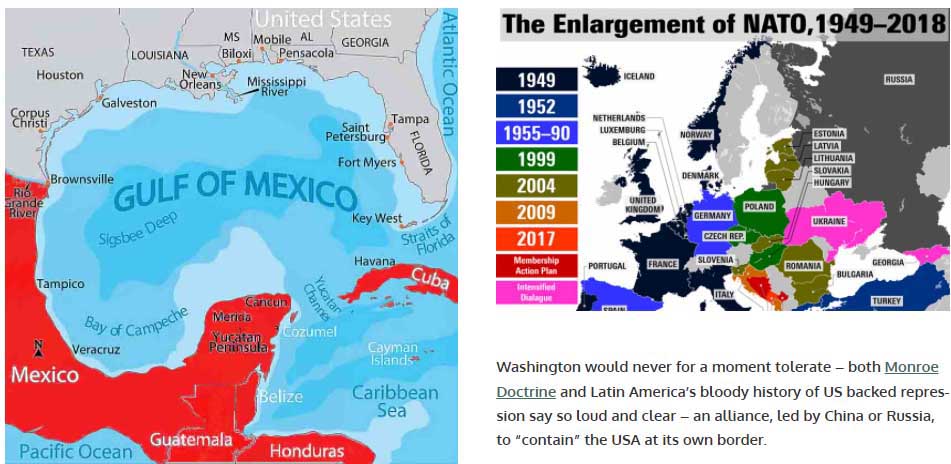
For a fuller account of Nato provocations of Russia, see A Ukraine timeline.
“….a desperate attempt to stave off the US from a historically fatal humiliation and geopolitical defeat at the hands of China.”
An observation/conclusion underscored in Warwick Powell’s latest analysis……
https://warwickpowell.substack.com/p/the-illusion-of-american-leverage
……on the current tariff and trade war,
“In response to China’s announced export controls on rare earth elements and other materials (9 October 2025), the US administration, from President Trump down, spent a week ramping up its rhetoric on tariffs against China. The President himself threatened the application of 100% tariffs, and Treasury Secretary Scott Bessent came out swinging. He basked in erroneous trumped-up reports of the dismissal of China’s trade negotiator, Li Chenggang, only to be humiliated when Li arrived in Kuala Lumpur with a bounce in his stride for trade talks.”
Which, in the context of the RAND piece, begs a number of practical questions.
Not least of which being is there anyone remaining in the current and future upcoming US/Western political class and culture – after half a century of deliberate dumbing down to the point where Hollywood films like ‘Idiocracy’ and ‘Don’t Look Up’ (not forgetting ‘The Big Short’) are effectively documentaries – cognitively capable of the level of maturity necessary to take such a route map?
And that is before consideration of the questions of;
a) an exceptionalist culture with an almost 100% track record of being agreement incapable;
b) the level of influence of it’s, ahem, ‘allies’/(Minders?) in the country which is an adjunct to the City of London;
c) the need to plunder resources because the culture no longer has the wherewithal to do anything else.
It is difficult to envisage the odds on the US/West taking such an approach as laid out by RAND not being longer than the those of the legendary ‘Mally No show’ in the Clint Eastwood film, ‘The Gauntlet’.
Too all or nothing, methinks. All are entitled to opine and guess, but nuance is advisable. We needn’t suppose US elites ready yet to retreat globallly and, as per current thuggery over Venezuela, double down on Monroe Doctrine – though this can’t be ruled out long term. Much less of a stretch however to see a ruling class, mauled by China’s robust response to Trump’s erratic swings, signalling intent to rein him in.
“nuance is advisable”
Indeed.
Perusing the outline of the report contained in that first link supplied by Simplicius….
https://www.rand.org/pubs/research_reports/RRA4107-1.html
…..this part jumps out:
“Clarify U.S. objectives in the rivalry with language that explicitly rejects absolute versions of victory and accepts the legitimacy of the Chinese Communist Party.”
Along with this:
“In the U.S.-China science and technology rivalry, manage the worst aspects of emerging technologies for mutual security and the condition of the rivalry, and step back from the most extreme versions of efforts to undermine the other side’s progress.”
Both contained within a larger context of [to quote Simplcius, again] “how rival global powers can coexist, and have done so in the past” citing détente between the USA and the USSR as a template.
A template which the historical record of the Brzezinski doctrine designed to undermine the Soviet Union demonstrates was, like so many other “agreements” and accommodations signed by the US/West*, not worth the paper it was written on.
The Chinese would do well to remember that the people and culture they are dealing with here hold the patent and copyright on the concept of forked tongue.
*Gorbachov (unification of Germany) and Putin (Minsk 1 & 2)being just the latest to join a long, long list of leaders betrayed by a culture built on duplicty.
Agreed
Hi Phil,
Reading through Simplicius yesterday I also read through the Rand offering which although aligning with some obvious facts but was suspicious and thought of it as rather a contrived delivery intended as a secret message on how to hoodwink the Chinese by playing nice for a bit. The groupthink that passes for US politics is so far down the road of sane I couldn’t imagine for one minute that such clever tactics could ever fall on anything but deaf ears and long lost brain cells.
I really have become that much of a cynic in my dotage.
Regards,
Susan
Nevertheless, the signs are of a US elite, or an influential wing, looking to rein in this chaotic administration. FWIW a piece today in the Economist asks if Trump seeks to set aside the Constitution and grab a third presidential term. If so, and if the ruling class allowed it by refraining from using its many levers to remove a leader past his usefulness, that would indicate a degree of desperation sufficient to embrace the full fascism WSWS and others have been warning of for years.
Though this could in theory sit with a pragmatic division of the planet into spheres of interest. And even a temporary freeze of aggression would favour China – not known for starry eyed credulity and with time on its side.
Hope you are right although I won’t hold my breath.
Susan
And:
The newly inaugurated Prime Minister of Japan, Sanae Takaishi, had widely been expected, on taking office, to deliver strong anti-China rhetoric; to strengthen the alliance with the U.S.; to boost Japan’s military power; and to contain Beijing. Yet, the opposite happened.
In her first address to the nation, Takaishi said that she would not support the U.S. trade war against China, and would not become an instrument of U.S. economic pressure. She openly criticised Trump’s tariff policy, calling it ‘the most dangerous mistake of the 21stcentury’.
Reuters commented that her stance was wholly unexpected in Washington. A big shock. It emerged that since taking office, the new PM had held a series of meetings with the largest Japanese corporations who had conveyed a unified and urgent message to her: Simply – the Japanese economy would not survive another trade war.
Then, one week after taking office, she openly expressed support for China, executing the biggest foreign policy pivot since WW2. China was no longer the ‘enemy’.
https://strategic-culture.su/news/2025/10/29/world-financial-and-geo-political-framework-at-time-of-imminent-disorder/