
Remember that Castlemaine XXXX ad from the eighties? The one where blame for a collapsed pick-up in the Ozzie outback is attributed not to crate after crate of lager bearing down on its creaking suspension, but to two bottles of sherry added – “something for the ladies?” – as an afterthought?
I think of it whenever I’m told Venezuela’s decades of suffering are the result of Failed Chavism. You needn’t be a starry-eyed Chavez/Maduro idoliser to grasp that ‘Chavismo’ is to Washington what those two bottles of sherry are to crate on towering crate of amber nectar bearing down on the coil springs and shock absorbers of that cruelly abused truck.
Two very different takes on why that is, and why an already perilous global stand-off just got worse through crude threats 1 to a country befriended by Russia and China, are that of Professor John Mearsheimer, archdeacon of the ‘Offensive Realism‘ school, and that of the GrayZone’s investigative journalist Max Blumenthal.
The professor adopts a geostrategic approach we can fairly summarise as “sauce for the goose is sauce for the gander” …
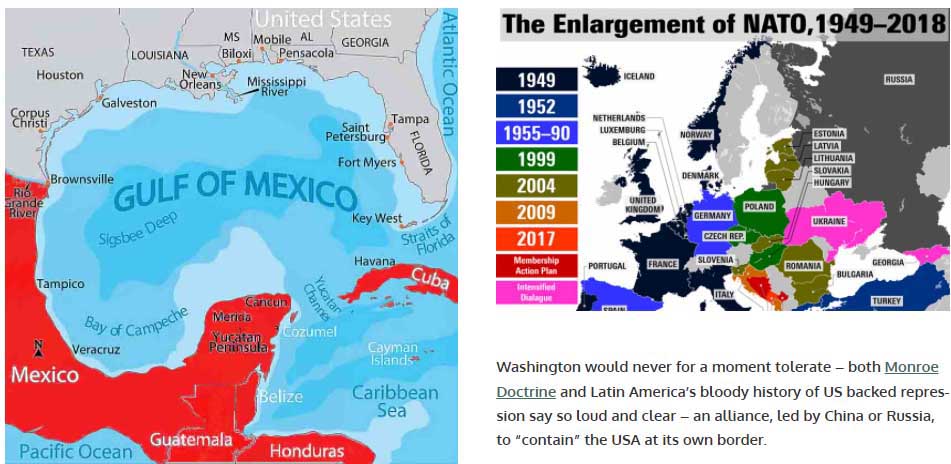
Used often in my Ukraine posts to counter the “Putin’s unprovoked war” nonsense
… which is all the introduction needed, but please ignore the sensationalist, clickbait packaging now seemingly obligatory in YouTube offerings. I have my differences with the prof’s Offensive Realism but sensationalist he ain’t. The man deserves our respect and merits our attention.
For his part the GrayZone’s impressive investigator focuses on the crimes against Venezuela not just of Trump 2 but of every US administration – Clinton, Bush Jnr, Obama, Trump 1 and Biden – since Hugo Chavez ousted his country’s comprador elites to take office in 1999. For reasons set out in yesterday’s post on the late Dick Cheney, I do not use the word, criminality, lightly.
No more does Max Blumenthal.
* * *
- Two weeks ago, in Roaming charges on a benighted planet, I asked:
is it just oil – more a means of leverage than vital resource for an energy rich superpower – that drives US acts of murderous piracy on Venezuelan fishing boats in the name, ridiculous in more ways than one, of The War On Narcotics? Or is such transparent thuggery a Monroe Doctrine reassertion; a reminder to a South America cutting deal after Belt & Road construction deal with Chinese operators that this is Washington’s fiefdom, with Beijing and Moscow unwelcome?
On the absurdity of accusing Maduro of heading a fentanyl/cocaine cartel, see Time Magazine, November 3 2025: Venezuela’s Opposition Is Using Misinformation to Promote Regime Change. Being Time Magazine, an East Coast Establishment outlet blind to the systemic criminality of Washington, it shifts most of the blame to Nobel Peace Prize winner (as if that Prize needed further besmirching) and Netanyahu crony María Corina Machado, while taking swipes at the detested Trump and his Secretary of State and concluding with the mandatory decrying of Maduro as a “heinous dictator”.
The author, an academic guest writer, notes nevertheless that:
Marco Rubio, hailing from a family of Cuban immigrants to South Florida, has long sought regime change in Venezuela, and now has the chance of a lifetime to make it happen. The one impediment is that Trump has never cared a whole lot about human rights or democracy and is a long-term critic of regime change operations. But the idea of Maduro as the head of a criminal enterprise terrorizing the United States has allowed Rubio to repackage military action against Venezuela as an anti-narcotics campaign. The idea that the go-fast boats blown up by U.S. drones were operated by Tren de Aragua is also without evidence.
See also this Al Jazeera piece from August this year – Mexico has no evidence linking Venezuela’s Maduro to drug cartel.
Well, there is a possibility that Russia will introduce the US to their own Ukraine on their own doorstep. As well as recently signing military treaties with Cuba, –
“First Deputy Chairman of the State Duma Defense Committee Alexei Zhuravlev has raised the possibility that Russia may deliver long range cruise and ballistic missile systems to equip the Venezuelan Armed Forces, providing the country with a deterrent at a time of high tensions with the United States. “Information about the volumes and exact types of what is being imported from Russia is classified, so the Americans could be in for some surprises,” he stated, adding: “I also see no obstacles to supplying a friendly country with new developments like the Oreshnik or, say, the proven Kalibr missiles; at least, no international obligations restrict Russia from doing so.” The deputy chairman made this statement while confirming deliveries of new Pantsir and BuK-M2 short and medium range air defence system to enhance the Venezuelan Air Force’s capabilities.
Lower profile alternatives to the Oreshnik which could be delivered more quickly include the 9M729 Novator ground-launched cruise missile system, and the Bastion coastal defence system which deploys P-800 medium range anti-ship cruise missiles. The former has a 2500 kilometre range sufficient to strike targets across Florida. Although Russia has during prior periods of high tensions between Caracas and Washington deployed Tu-160 strategic bombers for operations from Venezuelan airfields, equipping the Venezuelan Armed Forces with the ability to retaliate independently both against targets on the American mainland and against U.S. Navy warships in the Caribbean would potentially be much more effective, and would reduce the burden on the Russian Armed Forces to protect their security partner.
https://militarywatchmagazine.com/article/venezuela-receive-russian-missiles-deter
Hard to gauge the weight of that, Jams. I’m finding serious consideration of such an escalation ladder elusive. The piece you link to opens with this …
… and continues with a few train-spottery comments on Russian capabilities I don’t doubt. What it doesn’t address is (a) the likelihood of such an escalation; (b) the logistics of backing Caracas should the US retaliate. In Ukraine, decades of baiting Russia have been possible through its capture of European elites. While parts of Latin America are registering unease with Washington, and both Russian and Chinese – and to some extent Iranian – presence has been steadily growing, the axis of resistance has no equivalent of NATO (and its political wing, the EU) in the region. I don’t see these things considered in the Military Watch piece or elsewhere. Am I missing something? Wouldn’t be the first time.
I don’t think you’re missing anything – I just noted it as a possibility, but as you indicate, there are many steps on the way. It might just be a small jump in the escalation ladder, with crossed fingers that it won’t be needed, and no real plans made – yet. But Russia is for example engaging in (two-way) armaments trade with Iran and North Korea – Venezuela wouldn’t be an impossibly huge step, especially after an inconclusive conflict like the Iranian one.
A Defend Democracy piece by Dave de Camp two days ago adds its two pennoth – and little else – to the question …
NK has a land border with Russia (and China). Iran has the next best thing: it faces Russia across the shared lake of the Caspian Sea. Surely the logistics of supporting either are vastly simpler than those of supporting Venezuela?
Again I stress that my knowledge here is vanishingly small …