
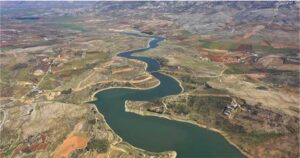
Lebanon’s rivers are more than lifelines. They lie at the heart of a long-standing struggle shaped by external ambition. From the Litani to the Wazzani, Israeli efforts to dominate regional water show that control over Lebanon’s water has been pursued as power, not necessity.
*
The Litani river rises sixty kilometres northwest of Beirut, in Lebanon’s fertile Beqaa Valley, to flow over a hundred kilometres southwest before turning westward to enter the Mediterranean respectively north and south of the biblical cities of Tyre and Sidon.
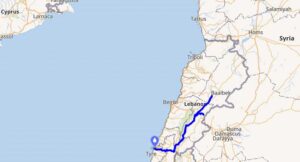
In a land unusually well watered by regional standards, the Litani is the only major Lebanese river to flow entirely within the country’s borders. It has no other littoral states, though a long standing Zionist – Greater or Biblical Israel – goal has been to change that …
… much as the illegal occupation of the Golan Heights – a theft impossible without western and more especially American 1 support – made Israel, de facto, the sole littoral state on the Sea of Galilee.
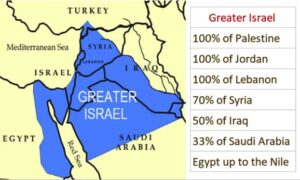
Israel’s expansionism, when not claiming buffer zones against perils of its own making, looks for legitimacy to conflictual texts written between the 7th and 1st centuries BCE and known as the Old Testament. Genesis 15:18-21, for instance, defines the land granted by Jehovah (a “jealous God” with psychotic leanings who collectively punishes by visiting the iniquity of the fathers on the children unto the third and fourth generation) as extending ‘from brook of Egypt to the Euphrates’. Numbers 34:1-15 is more parsimonious while Deuteronomy 7:22 and Exodus 23:29 promise lands to be given piecemeal to the children of Israel over many years.
Litani River … Sea of Galilee (a freshwater lake) … Brook of Egypt … Euphrates … even the Nile. Is there a pattern here of a resource set, as climate change accelerates, to overtake oil both as vital resource and poisoned chalice for nations who have it in relative abundance?
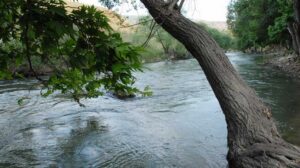
The Litani in the Beqaa Valley
Just as Washington seeks to control oil for reasons which go far beyond America’s consumption needs or even those of profit as narrowly defined – see It’s all about Iran’s Oil China, stupid! – does Israel seek to weaponise water across the Middle East for reasons that go beyond its own consumption needs?
Over to Dr Marwa Osman: mother of three, assistant professor in Media & Communication at Lebanon’s Maaref University. Host and co-producer of the MidEaStream political show, and magazine show Exposé at Iran’s Press TV, she is also an international affairs advisor to the Secretary General of the Global Gathering in Support of the Choice of Resistance.
Water, Power, and Geopolitics: Zionist Israeli Ambitions and the Hydro-politics of Southern Lebanon
April 27, 2026
Lebanon’s rivers are more than lifelines; they lie at the heart of a long-standing struggle shaped by external ambition. From the Litani to the Wazzani, the Israeli entity’s efforts to dominate regional water reveal a deeper reality: control over southern Lebanon’s water has been pursued as power, not necessity.
Water has long shaped the politics of the Middle East, but in Lebanon, it is becoming something more: a fault line of power, pressure, and persistent external interest. In the country’s south, where rivers like the Litani, Hasbani, and Wazzani carve through fertile land and contested borders, freshwater is not just a resource; it is a strategic asset increasingly entangled in regional rivalries.
For decades, Israeli entity efforts to secure water dominance have extended beyond its borders, repeatedly intersecting with Lebanon’s most vital water systems. From attempts to reach the Litani to tensions over the Wazzani’s flow, these moves reflect more than short-term necessity; they point to a deeper, long-standing strategy rooted in control over the region’s hydrological map.
This article explores how Lebanon’s relative water abundance has placed it at the centre of a quiet but consequential struggle, one where geography, politics, and resource security converge, and where rivers have become instruments of influence as much as sources of life.
The Hydro-political Significance of Lebanese Water Resources
Lebanon occupies a uniquely sensitive position within the hydro-political landscape of the Middle East. Unlike many of its regional counterparts, which suffer from acute water scarcity, Lebanon possesses comparatively abundant freshwater resources. This relative abundance, however, is not merely a natural blessing; it is also a geopolitical liability. In a region where water is increasingly securitised, Lebanon’s rivers and aquifers have become embedded within broader regional power dynamics, particularly in relation to the Israeli entity’s long-standing water concerns.
Lebanon’s hydrological system is defined by a combination of surface and groundwater resources. The country hosts approximately 17 perennial rivers alongside numerous seasonal streams and significant underground aquifers. Among these, the Litani River stands out as the most significant internal watercourse, stretching approximately 170 kilometres entirely within Lebanese territory. Its basin supports extensive agricultural activity in the Bekaa Valley and southern Lebanon, while also contributing to hydroelectric production through facilities such as the Qaraoun Dam. This internal positioning makes the Litani particularly valuable, as it is one of the few major rivers in the region not shared across international borders.
However, the hydrological importance of Lebanon extends beyond the Litani. Southern Lebanon is home to the Hasbani River and the Wazzani River, both of which form part of the upper Jordan River Basin. Unlike the Litani, these rivers are transboundary in nature, linking Lebanon hydrologically to Syria, Jordan, and occupied Palestine. This interconnectedness elevates their strategic significance, as any alteration in their flow has implications for the broader regional water balance. Transboundary water systems in the Middle East are often sites of asymmetrical power relations, where upstream and downstream actors compete not only over resources, but also over political influence.
The Wazzani River, a modest yet strategically significant watercourse in southern Lebanon, flows through the Marjayoun District within the Nabatieh Governorate, an area where geography and geopolitics intersect with unusual intensity. Despite its relatively small size, the river derives considerable importance from its source, the Wazzani Spring, which constitutes the only perennial and stable contributor to the Hasbani River. In hydrological terms, this spring accounts for approximately one-fifth of the Hasbani’s total discharge, rendering it a vital element in the broader Jordan River Basin.
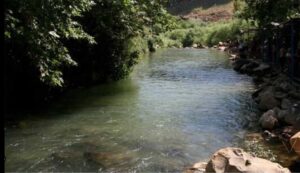
The Hasbani River
What distinguishes the Wazzani River is not merely its hydrological contribution, but its geopolitical positioning. Over a stretch of roughly four kilometres, the river delineates a sensitive boundary zone between Lebanese territory and the Zionist Israeli-occupied Syrian Golan Heights, particularly around the village of Ghajar. This dual function, as both a vital water source and a de facto boundary marker, places the river at the heart of regional tensions, where issues of sovereignty, resource allocation, and security converge due to constant Zionist aggressions on Lebanon.
Meanwhile, the Hasbani River originates from the northwestern slopes of Jabal al-Sheikh, descending through southern Lebanon as one of the principal resources feeding the upper Jordan River Basin. Flowing for approximately 24 to 40 kilometres within Lebanese territory, it represents a critical transboundary watercourse whose significance extends well beyond its geographical modesty. Hydrologically, the Hasbani integrates contributions from several springs, most notably the Wazzani, forming a steady flow that plays a vital role in sustaining downstream systems. Its position at the intersection of Lebanese, Syrian, and Palestinian hydrological networks situates it firmly within one of the most politically sensitive water basins in the Middle East.
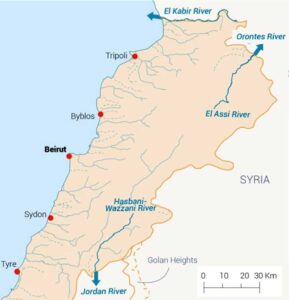
Lebanon’s shared surface water resources
This strategic positioning has rendered the Hasbani a recurring focal point of geopolitical tension, particularly in relation to water allocation and control. Disputes over its tributaries, especially the Wazzani Spring, escalated in the early 2000s following multiple Zionist aggressions, when Lebanese efforts to utilise these waters triggered Israeli severe objections and military posturing over pumping rights. Yet, beyond its political dimension, the river also carries ecological importance …
Read the rest of Dr Osman’s piece …
* * *
- The USA alone recognises Israel’s occupation of the Golan Heights as lawful. After the fall of Bashar al-Assad’s government in December 2024, that fall cheered on by liberals including many a Palestine supporter, Israel extended its decades old theft by moving into the UN monitored demilitarized zone on the Syrian-controlled side of the Golan.