
I’m on record as saying Andrew Korybko irritates the incredibly rude word beginning with the sixth letter of the alphabet out of me. On many matters I disagree profoundly and viscerally with his take. There’s no denying though that, like Heineken, this Russian speaking American reaches the parts – Horn of Africa through Bangladesh to Central Asian ‘Stans’ – where other pundits seldom go …
… with Belarus one of his many stomping grounds. If you’ve followed any of my outpourings on Ukraine, you’ll be familiar with this map and derivatives thereof:
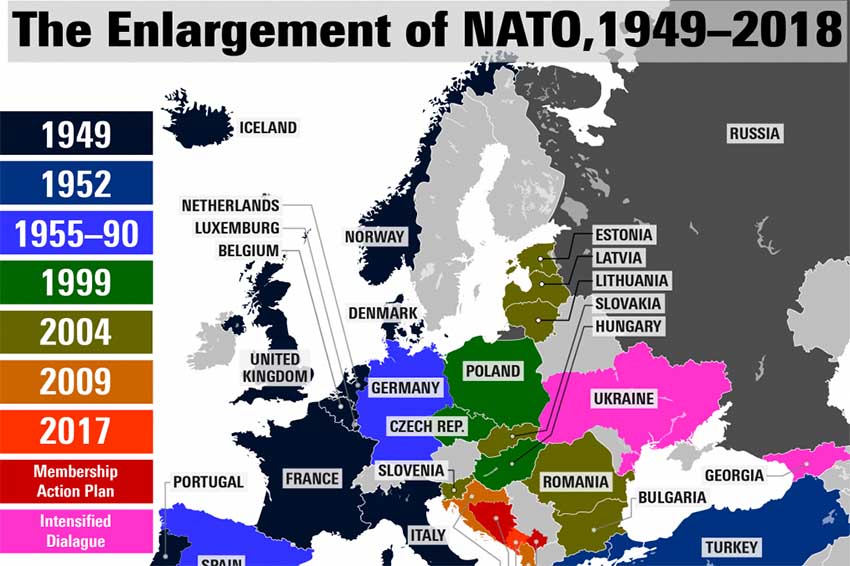
Belarus, unnamed above but shown in fetching grey on Russia’s southwest border – northeast of green Poland and north-northwest of pink Ukraine – has a bulls-eye painted on it by Nato’s missionary arm, the EU. That’s why Alexander Lukashenko, like Hungary’s Viktor Orbán – and neither for the reasons of authoritarianism that Guardian, Economist and their ilk likely believe and would certainly have us believe – is reviled by the West’s opinion manufacturing industries.
Always disregard the sales pitch and window-dressing. Always ask: cui bono?
Back to the man who irritates the fuck out of me even as I find his an indispensable voice. Today Mr Korybko’s substack hosts this:
The West Wants Belarus To Replace Supposed Russian Vassalage With Actual Polish Vassalage
The West already turned Ukraine, Armenia, and Moldova into anti-Russian states while stirring trouble in its ties with Azerbaijan and eagerly eyeing Central Asian leader Kazakhstan so the loss of Belarus would practically complete Russia’s strategic encirclement.
The Guardian ran a piece on US-led overtures to Lukashenko, an attempt to tempt him into rebalancing Belarus’ ties with Russia through closer cooperation with the West. I assessed here that he’s unlikely to split with Putin, especially after the West tried to coup him half a decade ago and Russia since gave Belarus tactical nukes, which Lukashenko confirmed in early August’s interview with Time Magazine.
But while his intentions shouldn’t be doubted given his loyalty to Russia throughout the special operation and associated pressure placed on Belarus, this doesn’t mean the West won’t try to mislead him into drifting closer towards its camp. To be sure, the “EU Defense Line” being built along the bloc’s border with Belarus (and Russia) resembles a “new Berlin Wall”, as his Foreign Minister described it, which could impede cooperation.
At the same time, however, the US could leverage its sway over Poland to offer Belarus security guarantees against the future aggression Lukashenko fears from it. He arguably considers this scenario credible enough to release several waves of prisoners as goodwill gestures after meeting high-level US envoys in Minsk this past year. If Belarus’ security interests are ensured, which is possible, economic incentives for rebalancing its foreign policy could follow.
Poland briefly closed its border with Belarus last month at cost of EU-Chinese trade, €25 bn (or 3.7%) of which is conducted across its frontier, after fearmongering about its drills with Russia. Even so, President Karol Nawrocki is likely to comply with whatever demands Trump, an ideological ally, might make so we can’t rule out Poland leading the EU dimension of the West’s rapprochement with Belarus. It’s thus far eschewed doing so but that could change under his leadership.
Nawrocki sees Poland becoming the US’ top ally, which means going along with its requests, to obtain support for its grand strategic goal of reviving Great Power status via a Three Seas Initiative which could one day reach Belarus. Poland, now a trillion-dollar economy, was invited to next year’s G20 Summit, so could foreseeably allow low or no tariff Belarusian imports as incentive for closer ties should tensions decrease.
This would align with Western interests but lead to Belarus replacing what the West calls ‘Russian vassalage’ with actual Polish vassalage. The military-strategic objective is for Lukashenko to trust them enough to ask that Putin take back Russia’s tactical nukes and Oreshniks. On the political front, they want his chosen successor (Lukashenko says he won’t run in 2030) to continue this Western course, worsening Russia’s security.
The West made anti-Russian states of Ukraine, Armenia and Moldova while stirring trouble in Azerbaijan and eyeing Central Asian leader Kazakhstan. Loss of Belarus would practically complete Russia’s encirclement. Russia is responsible for Belarus’ continued socio-economic stability through decades of generous energy subsidies and access to its enormous market, and helped quell 2020’s Color Revolution, so Lukashenko should know better than to betray it.
Gratitude being a famously short lived emotion – and elected politicians being unable to resist short term goodies, regardless of Uncle Sam’s form on throwing yesterday’s ‘friends’ under the bus – I guess we’ll just have to wait and see.
* * *