
Iran has shifted the entire calculus and achieved something long thought impossible. For years it was considered unthinkable that Iran would ever strike Israel directly, even after Iran was hit first. Then Iran began responding to Israeli attacks, first with ‘demonstrative’ strikes, then increasingly crippling ones.
Now Iran has established total strategic dominance of the escalation ladder to the point where it can treat Israel as Israel has treated other regional countries since its founding, punitively hitting it at will for violations that no longer necessarily include direct attacks on Iranian territory.
And the most shocking kicker of it all is that the US cannot do anything about it.
Simplicius, June 9
In the early hours yesterday, Iran for the first time launched hypersonic missile attacks on Israel that were not tit for tat retaliations for Israeli strikes on the Islamic Republic. Rather, they signal Iranian intent to regard all and any attacks on Lebanon and Hezbollah, and Gaza and Hamas, as breaches of a ceasefire it had many times insisted on applying – “everywhere or nowhere” – beyond its own borders. At the same time Hezbollah stepped up drone and missile attacks on the IDF ground invasion of Southern Lebanon, while Yemen’s Ansar Allah “Houthis” declared the Bab el-Mandeb choke point between Arabian Peninsula and Horn of Africa, with its control over access to Red Sea and Suez …
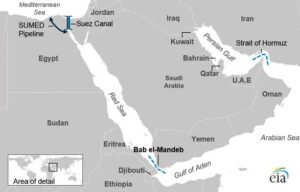
… closed to Israeli and Israeli linked shipping.
The simplistic narrative peddled by Western media of Hamas, Hezbollah and Ansar Allah being proxies who take direct orders from “the head of the snake” in Tehran is refutable on multiple grounds but, almost amusingly here, one measure of all three being allies not proxies is given by the fact that Iran’s interests would be better served, as Yves Smith observed yesterday in Naked Capitalism, by Ansar Allah holding back on its proven ability to shut down the Red Sea. Closing a second choke point at Bab el-Mandeb – the mere threat spiking insurance premiums – would have greater impact a few weeks down the line, when oil prices still kept artificially low by the West’s releasing of reserve stocks can no longer be so protected. The multiplier effect of closing Suez as well as Hormuz would have vastly greater impact at that point.
This consideration in turn underscores the wider one that the US and Iran are engaged in a war of nerves. Can Washington, unable for reasons touched on in yesterday’s post to break Iran’s grip on Hormuz, starve it into surrender? Or will Depression on a scale dwarfing that of the 1930s – initially engulfing expendable Europe and global south, but soon reaching America – force the USA into another humiliating defeat?
I spent most of yesterday consuming alt-Media accounts of this renewal of direct hostilities between Israel and Iran. Still convalescing, I haven’t the energy to summarise and synthesise but can recommend, though in no instance unreservedly – triangulation remains, as ever, of the essence – the aforementioned NC piece by Yves Smith, and the YouTube offerings of:
Danny Haiphong interviewing Elijah Magnier
Nima Arkhorshid interviewing ex CIA analyst Larry Johnson
US Colonel Doug MacGregor: Tel Aviv Burning, Haifa in ruins. How long before Israel collapses?
Since the shortest of these runs to forty minutes, also worth a watch is a source I’d never put at the top of my go-to list but here offers a useful interview by Owen Jones of Trita Parsi. Weighing in at a sprightly 20 minutes, it sports the clickbait but hardly misleading header: Why Israel is PANICKING.
Enjoy, if that’s not too inappropriate a term. Meanwhile I’ll be organising my thoughts for a post on the wider ramifications of the war, while picking up on a question currently exercising anti-imperialist circles. Is the empire, beneath its seeming difficulties in the Middle East, playing a much longer game – outcome unknown – of total planetary dominance over energy supply?
* * *