Before I get to the main item as advertised in the header, let me offer a Media Lens assessment of a Guardian piece by chief liberal Zionist – if you’ll excuse the oxymoron – Jonathan Friedland. I’ve disliked this man’s outpourings since a piece years ago – can’t source it without more time than I’m willing to invest – where he called on Jews to “have the maturity” to acknowledge the original sin of Israel’s foundations in murder, expropriation and ethnic cleansing, only to follow with standard Holocaust-invoking apologetics on why it had to be.
Palestinians? A regrettable but necessary collateral cost …
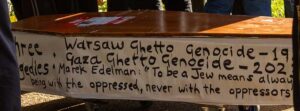
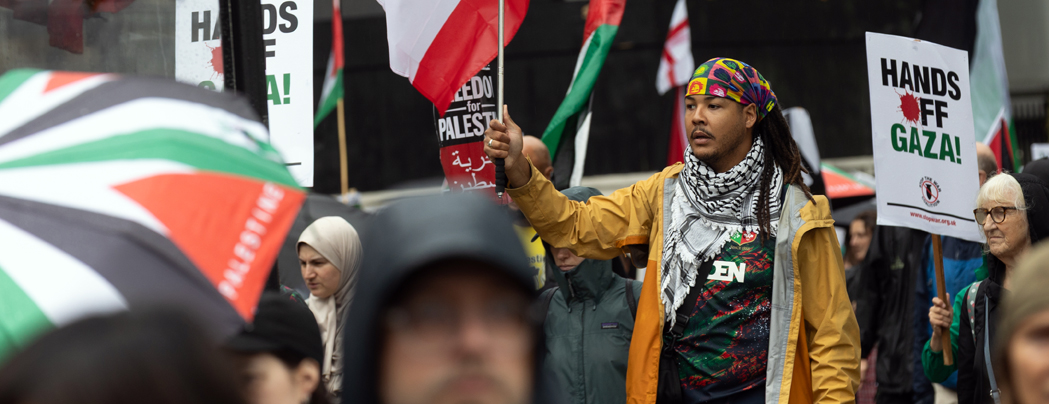
Snapped at a Gaza protest in London, November 11, 2023
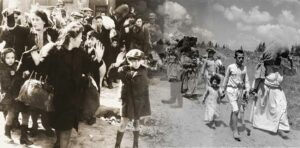
Photoshop composite of two iconic images: Warsaw 1944, Palestine 1948
*
I too had scanned Friedland’s contribution – The rise and fall of Kier Starmer: where did it all go wrong?– to the anodyne corporate media outpourings following Starmer’s announcement of intent to stand down. With too much on my plate, and needing to press on with an overdue follow up to US control of global energy? Part 1, I resisted the temptation to post on its many shortcomings. But within hours of its appearance in the Graun on Monday June 22, Media Lens was tweeting its response:
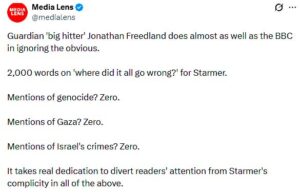
Not for the first time this week, ML took the words right out of my mouth.
*
During the dirty war on Syria and its attendant carpet demonising of all things Damascus by empire-subservient corporate media, I knew of only two Western journalists reporting from within the country. One was Canadian Eva Bartlett, the other British-American Vanessa Beeley. I thought both a little too uncritical in their defence of Bashar al-Assad, described by Simplicius after Syria’s fall to Western backed Islamist terrorists as:
… a tragic figure in that while he was a good man and kind leader, 1 he may not have been an effective leader. He was never meant to be ruler. He was a simple doctor-in-training while his older, firmer brother Bassel al-Assad, elder son of Hafez, was to inherit the throne but died in a car accident … 2
But I respected their dedication, its most frequent reward vile abuse not only from media hacks in London and New York but also and unforgivably from a far Left examined in my post, Syria: how Trotskyism got it so wrong. And I deemed uncritical admiration of Assad, though leading to overly optimistic expectations in that war of imperial aggression, a peccadillo at side of the opinion-manufacturing propaganda blitzes lapped up by Western publics addicted to outrage porn no matter how credulity stretching or evidence defiant. 3
I still have carps with Vanessa Beeley’s Middle East writings. She strikes me as wide of the mark in her criticisms of Russia and China for Not Doing Enough For Palestine. It’s not at all clear to me what she’d have them do given that (a) any state’s first priority is to pursue its own interests, broadly interpreted; (b) precisely because Russian and Chinese military might, while daunting, is defence oriented, it lacks US ability to project power thousands of miles from its borders.
Nevertheless, the detailed local and regional knowledge Vanessa brings to bear is why I’m still a subscriber. Her post today is a case in point. Not only does it do what no corporate media in the West are doing – holding empire to account for the bloodbaths, smoking ruins and lawless chaos its criminal wars leave in their wake. And not only does it offer a fascinating glimpse into the internecine strife engulfing Syria post Assad, and dividing the bewildering array of Sunni sects vying for control of that rape scene of a country. More important than either, it draws out a connection I myself have alluded to, though without the depth and granularity Vanessa brings to these squares on the global chessboard; namely, that the wars in Ukraine and Middle East/ West Asia are not separate, and it is seriously misguided of anti-imperialists to think otherwise.
Will Jolani stand down or is the Syrian strike force poised to enter Lebanon?
The pressure builds on Jolani to enter the Zionist bloc war against the Lebanese Resistance.
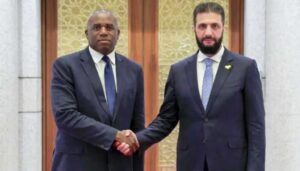
Not in Vanessa’s post: UK Foreign Secretary David Lammy with the self anointed Syrian president on whose head the US had a $10 million bounty – expediently removed upon Assad’s fall
The Syrian quisling President, selected by the enemies of Syria, has gone on record trying to explain what President Trump mean’t when he said Syria could deal with Hezbollah after Israel’s failure to defeat the Lebanese Resistance. In a recent interview Abu Mohammed Al Jolani said:
From President Trump’s statement, the answer is that he was expressing frustration with what is happening in Lebanon and looking for other solutions, and that there could be a positive role for Syria through the Lebanese state and Lebanese institutions.
In tones dictated for him by MI6, Jolani went out on a limb to deny the potential for any military action against Hezbollah and Lebanon – he said Syria should support the ‘Lebanese state, strengthening its institutions, and building channels of communication among the political parties and active forces in Lebanon, including Hezbollah, in search of a security solution that everyone can accept.’
Taking the words of a terrorist operative in the pay of the entire regime-change alliance that finally brought the war of resistance to an end in 2024, would be foolish. It is far better to surveil the surrounding operations and actions on the ground that belie Jolani’s dulcet tones.
In my first article on the ‘Burning Borders‘ I go into some detail about the build-up of a strike force along the eastern Lebanese border with Syria. My information is from very reliable sources inside and outside Syria who remain anonymous for their security.
After Ukrainian President Zelensky visited Damascus in April 2026, I started to receive reports of Ukrainian forces gathering, firstly in Tartous and now in western Aleppo. The same Ukrainian build-up was seen in Idlib, during the year prior to the HTS attack on Aleppo that resulted in the capture of Damascus in December 2024. It must be presumed that Ukraine will again supply drone technology and equipment to the Jolani militia, while perhaps enabling Jolani to despatch foreign mercenaries to the Ukraine-Russia frontlines.
On June 20th the US-led coalition in Syria bombed the headquarters of the Turkistan party in the Idlib countryside. Also assassinated was Sami Al Oraydi, a senior leader and ideological figure in the armed group Haras Al Din. HaD were a thorn in the side of the Jolani bid for power in Idlib. I reported, previously, on the US Coalition efforts to weaken HaD on behalf of Jolani, striking headquarters and command structures with coordinates provided by Jolani.
Since Jolani was handed power and dominance over Syrian territory – there has been a concerted attempt to dismantle the ideological vanguard of ‘global jihad’. The landscape of Idlib in north-west Syria has become a complex arena where the strategic objectives of international security intersect with shifting local power dynamics. The ongoing elimination of Al Qaeda/ISIS figures by the international coalition should not be viewed in isolation from the overarching objectives of the US-Israel-led alliance and the operational alignment of local actors, led by Jolani and Hayat Tahrir As Sham (HTS). Understanding this operational framework is vital to predict Washington’s agenda to neutralise any cross-border threats to their control of Syria and to the security of “Israel”.
The Convergence: Jolani’s Alignment with the Coalition’s Objectives
There is a predictable ‘civil war’ waging on many levels inside Syria but particularly within the ‘jihadist’ movement itself. Since his rise to power, Jolani has undergone an orchestrated political transformation, shifting from allegiance to ISIS and then Al Qaeda, to the role of a ruler that seeks international legitimacy.
This campaign by Jolani to rein in his more ideologically extreme positions, places him in opposition to the ideological hardliners and traditional guardians of Al Qaeda’s doctrine. This poses a threat to his MI6-model of governance and his outward narrative of “moderation and pragmatism” that he takes great pains to present to the West and regionally.
This has led to two results. First, the HTS campaign to dismantle, imprison and undermine the foreign extremist fighters and veteran leaders who reject the Jolani regime project. Secondly, there is a concerted backlash from groups like ISIS who have been leading attacks against Jolani’s militia …
Continue reading on Vanessa Beeley’s substack …
* * *
- Calling Bashar al-Assad a “good man and kind leader” will have most Westerners taking brainwashed umbrage so let me elaborate on Simplicius’s behalf. All three of the region’s Ba’athist states – Saddam’s Iraq, Gaddafi’s Libya and Hafez al-Assad’s Syria were marked by a ruthless authoritarianism which liberal cluelessness sees as that of power crazed tyrants with no redeeming qualities, while minds more critical factor in the ferocious post colonial conditions of their gestation. (There’s a clue in the straight lines of their borders, drawn by ruler in London and Paris.) In Syria’s case the threat to secularism, vital to a multi-faith state itself the product of Anglo-French intent to divide the post Ottoman Arab nation – the world’s largest ethnic group after China’s Han – posed by Sunni extremism informed Hafez al-Assad’s brutal repression, with many an innocent casualty, of the Muslim Brotherhood. The other half of this story (corporate media lies of omission being how they most commonly misinform us, regardless of the subjective sincerity of many if not most journalists) is that all three Ba’athisms had welfare programs, premised on state ownership of key economic sectors, which allowed healthcare and literacy levels comparable to the West’s but stood in the way both of neoliberal ideology and, more importantly – see General Wesley Clarke’s revelations – of US plans to set the Middle East ablaze and in the ashes build a new regional order answerable to Washington. The tragedy of Bashar al-Assad was that he saw the need to liberalise but lacked what it takes to advance so dangerous a project.
- I would put it more strongly than Simplicius – accusing Bashar al-Assad of laziness and arrogance in failing to build on the respite afforded by Russia’s aerial intervention by reorganising his country’s underpaid and increasingly demoralised army – but even to describe him as weak but decent was too much for those who fell hook, line and sinker for the vilifications of corporate media and statistically insignificant Syrian expats – as though a handful of disaffected refugees could speak for a multi-ethnic but secularist country of 17 million – and are now eerily silent on what has befallen Syria since he fled to Moscow.
- Most comprehensive of my many writings on Syria is Syria, Monbiot and Universalism. Though written in 2017, when my understanding both of Syria and empire was – as it now seems to me – painfully underdeveloped, I stand by almost all of it.