
… few doubt that the middle east is in the grip of epoch shaping convulsions. Nothing speaks more eloquently to this truth than the astonishing territorial gains of Yemen’s de facto government, Ansar Allah, and their attendant threat to a century of rule by another Western installed regime, the House of Saud.
Three takes on the ‘middle east’
The Ansar Allah threat goes wider than Saudi Arabia, taking in every US dependent monarchy in the Gulf, while thus far all talk of Türkiye and Pakistan helping out Riyadh and its superpower backer by placing boots on Saudi soil has with good reason proved so much hot air. And to the extent the House of Saud and settler colony exist in co-dependence, Israel too is endangered 1 by these tough, well equipped and motivated fighters; their numbers said to be 30,000 in 2015 when Riyadh set out with Washington/London backing and criminal disregard for civilian lives to destroy them from the air, only to throw in the towel eight years on. As did the US on May 7 last year when, after barely two months, the exposure of its fleet to Houthi missiles had been made all too clear to its naval commanders, 2 though of course that did not stop the reality-lite 47th POTUS from claiming a stunning victory.
And now? Even that empire mouthpiece, Voice of America, puts the number at 350,000 vastly better equipped and organised fighters. Against such a force a Saudi army structured first and foremost as a praetorian guard for the Western installed House of Saud, its baked in fractions aimed at minimising the possibility of coup d’etat, could expect nothing but annihilation. Hence those appeals from MBS both to an overextended Washington, and to his regional neighbours; appeals thus far falling on deaf ears given on the one hand so daunting a foe, on the other the fears, not just in every Gulf capital but in Ankara and Islamabad too, of waging a war likely to be deeply unpopular with their own citizens.
Meanwhile on the other shore of the Red Sea, President Sisi is similarly caught between a rock and a hard place. To greater extent even than America’s frightened clients in the Gulf, the Cairo regime, its very existence dependent not only on US funding but, in a pattern writ large across the middle east, on protection from its own citizens, can only watch in paralysed horror at what is unfolding across that narrow waterway to the southeast. Sisi shares with equally illegitimate US clients in the Gulf a menu of two equally distasteful options: defy a Washington capable of destroying him, or expose the country he rules on US sufferance to Ansar Allah’s long and ever more precise missile reach.
And like those Gulf autocracies, his predictable response is to walk a tightrope of prevarication.
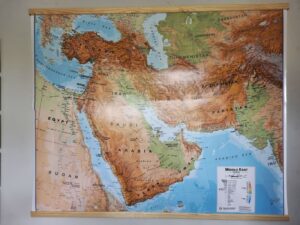
1200 x 1000cm regional map on the east wall of the Control Room at Steel City House
These and related matters were explored in a twenty minute dialogue, featured in my previous post, between Alex Christoforou and Alexander Mercouris at the Duran. But while the epicentre of their discussion was Riyadh and rippling outwards, what of Yemen itself? What of those Shia mountain warriors, their closest parallel the Sunni Pathans of Afghanistan who saw off not one but two military superpowers?
My cue to hand over to two women – one a liberal American, one a US-Yemeni citizen – in the company of Drop Site News host, Ryan Grim.
* * *
- In a dialogue five days ago on The View from India channel, the Quincy Institute’s Trita Parsi – a man I’d describe as not ‘alternative’ but on the fringe of mainstream discourse – speaks of an Israeli offer to put IDF boots on the ground rejected by Riyadh since, for a regime already detested by its subjects, overt Zionist support could only pour petrol on flames of the KSA’s own making. (One mark of Riyadh’s fragility and desperation here is given by its risible claim, believed by no one, that the famously devout Ansar Allah had targeted Mecca and Medina for drone/missile strikes.)
- More than any previous conflict, the twin wars in the middle east have exposed the ‘floating pointlessness’ of aircraft carriers in offensive operations. While effective in defensive settings – hence China’s continuing commitment to carrier building – their vulnerability when supply chains are extended has been made painfully apparent against two adversaries wielding drones and hypersonic missiles, with those chains lengthened by the destruction or abandonment of former bases in a war theatre many thousands of miles from home.
(In that same interview with The View from India, Trita Parsi offers another reason for Trump being antsy about a second round with the Houthis; that the orange narcissist is still pissed at MBS’s (prudent) denial of KSA airspace to US warplanes targeting Iran in the twelve day war last June. Me, I suspect that like all liberal pundits, even the good ones, Trita overstates the agency of US presidents.)
Thanks, Philip. Any news from Prince Naseem Hamed?
Ha! Surmising from your comment that my fellow Sheffielder and former featherweight world champ is of Yemeni stock, I checked. As you imply, he is that. I can’t give an up to date appraisal of his current fortunes – other than that the cocky fucker is said to be “worth” $35m – but can say that unlike Ansar Allah he met his match. Overreliant on a southpaw’s ability to wrongfoot combined with killer left hook and Tysonesque way of psyching out opponents before they’d stepped into the ring, his string of impressive victories came to an abrupt close against one of those whipcord sinewed Mexicans; a man Hamed couldn’t intimidate and who was technically the better fighter.
Oh, and the fact my partner of seventeen years (and wife of twenty-four days) had a run in twenty-eight years ago while pushing a pram containing her infant daughter along a steel city pavement needlessly narrowed by an arrogantly parked six-figure motor whose owner was visiting nearby premises. When Jackie challenged the apes minding the car she got an earful of evil till the champ came out to order them to shift it.
Hamed of course has form with cars …