
I don’t write much on the ecological effects of burning hydrocarbons. 1 I don’t write much about ecology, period, and on the few occasions I do it’s subsumed under the wider point that ecocide in general, a world overheating in particular, are part and parcel of the barbarism whose sole alternative is the socialising of wealth creation to allow production driven by human need not private profit. See my post of February 2020, Ecocide: the Mullah Nasruddin speaks!
To the disgust not only of liberals but of many Marxists I’ve long viewed China’s resurgence as not just inspirational but as offering, through its management of capitalism and refusal to allow finance capital a dominant position, humanity’s only realistic hope.
The far left’s refusal to distinguish on the one hand China’s state-monitored industrial capitalism, its big banks firmly outside the private sector; on the other the usurping of state control by the West’s oligarchs, leads it to dismiss China as a progressive force. Rather, crying plague on China and the West both, it embraces (or pays lip service to) a fantasy of violently overthrowing capitalisms armed to the teeth, versed in all the dark arts, and wielding tools of surveillance beyond the wildest dreams of the 20th century totalitarianisms. This, moreover, in a West whose export of industry has eroded the very socialising conditions – an exploitation experienced en masse in the dark Satanic mills of Marx’s day – which led him to see the proletariat as the only force with both the means and the motive to take humanity into socialism.
The car in front is Chinese and electric (footnote 1)
More specifically here, the ever shriller denunciations of China by Western elites, the corporate media who serve and ultimately answer to them, and their useful idiots whose name is Legion …
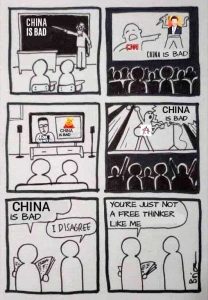
… have included routine denunciations of China as the world’s heaviest polluter and burner of fossil fuels, primarily oil and coal. Regular readers know my view that Western propaganda relies (even) more on lies of omission than commission, and so it is here. Those denunciations invariably left out two things. One, when we factor in per capita emissions, China’s 1.4 billion population puts it far below Western levels. Two, its emissions are due to its making our stuff, the rentiers who now control Western economies having found it more profitable to offshore real wealth creation while focusing at home on the diverse forms of rent extraction which have Yanis Varoufakis telling us capitalism has been superseded by what he calls technofeudalism. 2
More recently those denunciations seem to have tailed off. 3 In no small part I put that down to the truth, increasingly hard to rebut even by sleight of hand, that China is leaving the West in the dust on renewable energy. Why? Because it has to. With America still powerfully placed – how powerfully remains to be seen when the dust settles but no one should underestimate this – to squeeze global choke points including Hormuz and Bab al-Mandab, North West Passage and Malacca Strait, China can’t reduce its dependency on hydrocarbons fast enough.
And if its national interests coincide with those of an overheating planet, so much the better. Bear that in mind as you read yesterday’s short briefing from Progressive International.
As the US secures another century of oil extraction, cheap solar power and electric vehicles offer countries across the Global South a way out of fossil fuel dependence.
In the Progressive International’s thirty-seventh briefing of 2026, we examine the collapse of COP31, the financial and military power defending fossil fuels, and the clean-energy technologies offering the Global South a route out of dependence.
On Sunday, 22 November, COP31 ended without a deal. The stumbling block: fossil fuels. Saudi Arabia had fought to keep those two words out of the agreement. More than 130 countries insisted that they go in. Three years ago, at COP28 in Dubai, governments agreed for the first time on the need to transition away from fossil fuels. Now they could not agree to name them.
That total failure came a month after another part of the UN system found that, under current policies, the planet will warm by 2.8°C by the end of this century. Even if every country’s current climate commitments were delivered in full, the projected rise is still 2.6°C. So much for “1.5 to stay alive.”
This October was the hottest ever recorded, at 1.75°C above pre-industrial temperatures. In the Pacific, El Niño is likely to be the strongest on record. Its effects are already being felt thousands of miles away. In Ethiopia, lower rainfall, linked to El Niño, has damaged crops across Amhara, Oromia, and Tigray. Maize prices have reached record highs, rising 70–90% between December 2025 and September 2026. Switzerland has lost nearly one-fifth of its remaining glacier volume in just the last five years, more than 5% in 2026 alone. Across the Amazon, deforestation, degradation, and fires are turning one of the world’s great carbon sinks into a growing emitter.
Signs of planetary pain are everywhere. But for Big Oil, profits abound. Between April and June alone, ExxonMobil, Chevron, Shell, BP, and TotalEnergies recorded $48 billion in profits. In just three months, five oil companies made more in profit than all developing countries received to adapt to climate breakdown last year, around $30 billion, just a tenth of what the UN estimates is needed.
The US–Israeli war on Iran and the disruption to oil and gas shipments through the Strait of Hormuz helped produce Big Oil’s windfall. BP’s profit margin for refining oil nearly tripled: from $15.80 per barrel in the third quarter of 2025 to $46.70 in the same period this year. As the planet burns, the fuel becomes more profitable.
Those profits are backed by the world’s largest military power, which is also the largest producer of crude oil and exporter of liquefied natural gas. The US Energy Information Administration expects its crude production to reach a record 13.9 million barrels a day this year and climb further in 2027. In February, the Trump administration revoked the Environmental Protection Agency’s landmark finding that greenhouse gases endanger public health, stripping away a central legal foundation of federal climate regulation.
From the headquarters of the US Fifth Fleet in Bahrain to the vast Al Udeid air base in Qatar, US military installations encircle the Persian Gulf. The desire to control the region’s fossil fuels has shaped the architecture of US military power in West Asia for decades. In 1980, President Jimmy Carter established the Carter Doctrine: attempts by other powers to control the Gulf were henceforth seen as a threat to US interests and to be resisted by military force. This year, Iranian missiles and drones have struck US bases across the region, forcing the Pentagon to reconsider the deployment of its forces.
Even as the imperial grip is challenged in West Asia, it tightens elsewhere. Within four weeks of President Nicolás Maduro’s kidnapping by US Delta Force, Venezuela’s National Assembly had approved sweeping changes to its oil laws. The country holds the world’s largest proven oil reserves. In August, the White House announced “the biggest oil deal in world history”, which granted the US “majority control of more than 65 billion barrels of proven oil reserves in Venezuela”. US proven reserves stand at 46 billion barrels. The Trump Administration claimed the 100-year deal secures US “energy dominance for the next century—all at zero cost to the United States.”
Such a commitment to fossil fuels is a boon for more than Big Oil and Washington’s war planners. In 2025, the world’s 65 largest banks committed $906 billion to finance fossil fuel companies, almost 8% more than the previous year. Oilfields, pipelines, refineries, and gas terminals are enormous investments whose expected returns depend on continued extraction. A rapid transition away from fossil fuels would necessarily leave oil in the ground, pipelines unused, and still the necks of nodding donkeys, destroying the investments of shareholders and creditors. One study estimated that plausible changes to climate policy could erase more than $1 trillion in the value of future oil and gas profits.
From the oilfields of Venezuela to the war on Iran, Trump has loudly trumpeted the material interests driving his interventions. US military and political power are mobilised to defend and expand fossil fuel accumulation at the very moment the planet is crossing the threshold of 1.5°C warming.
Yet while the US doubles down on fossil fuels, a different energy system is taking shape at extraordinary speed, driven above all by China. The Middle Kingdom’s emissions fell 3.1% in the third quarter of 2026 while still producing almost a third of global manufacturing. In September, electric vehicles, including plug-in hybrids, accounted for 67% of Chinese passenger-car sales. Even half of all heavy trucks sold were electric.
Chinese manufacturers have dramatically driven down the cost of solar panels, batteries, and electric vehicles, making technologies once considered prohibitively expensive increasingly accessible across the Global South. Africa is on course to install 17 gigawatts of solar capacity this year, an increase of 45% on 2025. Thirty-six of the continent’s 54 countries are expected to set installation records. Much of this expansion is taking place on rooftops, farms, and commercial buildings, where solar panels and batteries are displacing expensive and dirty diesel generators. And the savings are more than environmental. Over the twelve months to June, Africa imported $2.4 billion worth of Chinese solar panels. Think tank Ember estimates that generating the same amount of electricity from diesel would cost approximately that much in fuel every three months.
Today, EVs compose a larger share of new car sales in Vietnam and Thailand than in Europe. In the first half of 2026, they accounted for 44% of new passenger-car sales in Vietnam and 35% in Thailand, both higher than Europe’s 31%. In Colombia, the figure reached 19%, almost double the previous year’s share.
These developments raise the possibility that fossil fuel dependency could become a thing of the past as Global South states leapfrog some of the infrastructure the industrialised world used to develop. Every diesel generator replaced by solar panels and batteries means less imported fuel; every electric vehicle replacing a petrol car reduces future oil demand. As the upfront costs fall, due in significant part to Chinese technological and manufacturing advances, these are costs avoided and money retained at home. For the owners of oilfields, refineries, and pipelines — and the banks and pension funds invested in and financing them — this future threatens to destroy revenues and the value of assets.
Of course, such a transition is not without its own contradictions. The production of batteries, solar panels, and their component minerals is concentrated in a handful of countries, and mining brings new struggles over land, labour, and environmental destruction. Many of the minerals in the solar panels Africa now imports from China were dug from her soil. Cheap technology alone cannot settle the question of sovereignty or reverse hundreds of years of imperial economic relations.
The technologies of a new energy system are spreading rapidly, threatening to strand fossil fuel investments while offering countries historically dependent on imported energy new possibilities for development. But the same financial and military power that has sustained the fossil fuel system is now being mobilised to prolong its life. The struggle ahead will require confrontation with the US-led ultra-fossil empire and the construction of the sovereign, democratic capacity to own and plan the alternative. Those questions will not be settled at COP summits.
* * *
- Should JSO be expanded to JSBO? As America’s war on Iran, and Iran’s response, are now beginning to remind the world through scarcities in fertilisers whose worst effects have yet to make their way along extended and thus far semi protected supply chains, we use oil for more than energy. So unless someone can explain to me, ideally in terms a child could understand, how eight billion people can be fed by organic farmers, I’ll take JSO to mean just stop burning fossil fuels.
- Long story short. The capital-labour relations studied by Marx are in an era of financial imperialism globalised on north-south lines: north to south export of monopoly capital; south to north repatriation of profits. It’s the recycling of those profits within the north (or West if you’ll allow me terminological latitude) that created the rent-seeking oligarchies Yanis likens to a new feudalism where debt replaces surplus value as the source of vast and economically dysfunctional wealth disparity.
(That the globalising of capital-labour relations is now under threat from a multipolarity spearheaded by China and exemplified by BRICS, and the imperialist West’s growingly reckless responses to that threat, are making the world more perilous by the hour is the underlying theme of most of my posts on this site.)
- In saying denunciations of China as the world’s prime polluter appear to be on the wane, I mean they are less often aired by Western propagandists, who have moved on to other themes like unfair trade allegations. But that doesn’t mean their effect has dissipated. Just as the weakly evidenced idea that “Guinness is good for you” lives on, decades after its use by advertisers was outlawed, so does the perception of China as an environmental menace outlive not just reality checks (mere evidence being effortlessly drowned out by power-serving narratives in an era of mass media answerable to tiny elites as I’ve argued here and here and here) but the quiet archiving of yesterday’s vitriol to make room for today’s.