I guess I like inserting the word ‘stupid’ in post titles. Here’s my reply to a comment by Anne on that of April 14, Blockade: US empire is evil, not stupid! For brevity I’ve omitted her comment, while retaining in block quotes the passages most pertinent here:
… the bombing of Iran’s transport infrastructure is to disrupt the rail and land transport that China is developing for oil in order China is less dependent upon more vulnerable sea routes …
Yes! Though a pipeline – a more ambitious project than the rail and road links of the New Silk Road arm of Belt & Road – could not only bypass the Malacca and Hormuz choke points, but allow oil transits in comparable volumes at comparable costs. On a brighter note Beijing’s awareness of its Achilles heel adds urgency to its pursuit of renewable energy, in which it leads the world – but also makes that world more dangerous given empire determination to stop the rise of China before it becomes independent of fossil fuels. (For energy I mean. We’ve no way of feeding 8 billion people without soil fertilisers derived from hydrocarbons.)
Even some of my favourite commentators like Jeffrey Sachs points to the psychopathic madness of Trump and his henchmen rather than seeing the evil goes much deeper.
I too have a soft spot for Professor Sachs, a man of good heart and brain, even as I note his balking at going the full shilling on the root of this darkness being empire refusal to let go of unipolarity.
Is it an inevitability that the rise of individualism and personal freedom leads to a profound dislocation from our mutual interdependence with ‘other’?
Homo sapiens sapiens is a social but individuated animal which must produce and daily reproduce the material conditions of existence and, ill equipped to do so alone, enter into social relations for that purpose. Our systems of law, morality and etiquette are imperfect ways of managing tensions, between ‘me’ and ‘we’, attendant on this stubborn truth. Under capitalism, especially its advanced, rentier driven imperialist forms, 1 the ‘me’ aspect is emphasised to a degree no previous society has attempted.
… Leading inexorably into a psychopathy that denies our collective responsibilities for each other – including animals, plants and the Earth itself. I don’t know. But it’s heartbreaking.
Yes again, utterly …
*
I’ve frequently voiced on this site my belief that:
- A waning US empire poses, through its lawless and increasingly reckless efforts to halt or even reverse its decline, far and away the greatest threat to world peace.
- The neoliberal, creditor driven economics this empire seeks to advance now place a tiny elite in existential opposition to the vast majority of humankind. This holds whether we look at it economically, ecologically or humanistically. Not that any of these things are at the end of the day separable.
- The best hope for humanity lies in China’s sane and responsible challenge to said empire. It’s not a popular viewpoint, either in the mainstream or in ultraleftist circles:
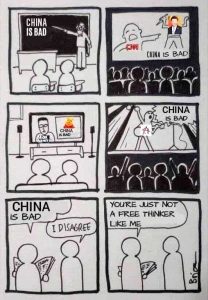
For a one-stop shop on my reasoning, see my post of five years ago, An open letter: isn’t China just as bad?
*
More than a century of Western meddling in Iran has been mostly but not always about oil, 2 and either way the immediate motives have shifted:
- The fall of the Ottoman Empire in WW1, coinciding with the rising importance of the black stuff, saw the Middle East sliced up by Britain and France (with Czarist Russian blessing) along lines calculated to sow discord within the Arab nation. 3 Witness, inter alia, Sykes-Picot severing of Lebanon from Syria, and Kuwait from Iraq.
- As for its non-Arab neighbour, in 1925 the British installed a soldier, Reza Khan Pahlavi, as Shah of Iran – only to depose him in 1941, fearing his closeness to Germany might open up Iran’s bounteous oil fields to Rommel’s tanks. RKP was forced to step down in favour of his son, a Mohammad Reza Pahlavi whose harsh rule kept his people in poverty 4 while his Western underwriters continued to extract their oil at bargain basement prices.
- In 1953 a popular leader, Mohammad Mossadegh, was elected prime minister of Iran on a platform of nationalising Anglo-Persian Oil (now British Petroleum). With help from Iran’s clerics, who loathed his liberal humanism, the British and Americans ousted Mossadegh.
- In 1979 the Iranian Revolution, a mass uprising appropriated by a clergy which went on to liquidate its secularist currents, deprived the US – which a decade earlier had emerged as supreme power in the Middle East 5 – of one of its two regional gendarmes. Only Israel remained, though the OPEC shocks of the early seventies, and consequent Faustian pact struck with Riyadh – not just on petrodollars but on giving a House of Saud with neither legitimacy nor popular support the status of US client – had made Saudi Arabia an option in waiting.
The rest of Iran’s ordeal at the hands of the West is too well known to require summary. It has to be said though that its decades of hardship have been less at the hands of ayatollah rule – understood in cartoon form by most Westerners and their faithless media – than of America’s economically crippling and literally murderous sanctions. That’s before we even get to the US-Israeli war crimes routinely perpetrated since last June.
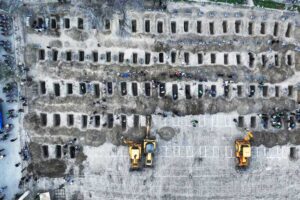
Burying 170 schoolgirls in Minab
For current purposes the main takeaway is that for the American Empire, its metropolis energy self-sufficient, the ‘business case’ for controlling oil is not for its own needs. Nor is it primarily about short term profits.
It’s about throttling China, stupid!
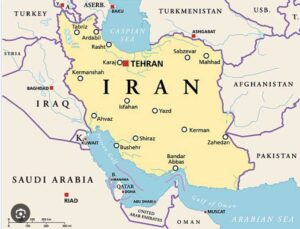
Not for nothing is the Strait of Hormuz called a choke point …
And for the why of that, let me hand over to Brian Berletic. You do got twenty-four minutes to spare, no? I consider this man one of the two or three most important voices on the alt-media scene and, if we further narrow the focus to planet-wide geostrategy, put him at numero uno.
One reason is this former US marine analyst’s diligence in using maps – too often missing from both mainstream and alt-media coverage – and the empire’s own words to back up his claims. Another is that in contrast to Scott Ritter, Pepe Escobar, Andrei Martyanov and many other anti imperialists of good heart and sound brain, he never falls prey to wishful thinking.
Which is not to say he peddles despair. As Jean Paul Sartre advocated, Brian Berletic looks to the future with the steady gaze of stern optimism …
* * *
- “… especially in its advanced, rentier driven imperialist forms …” There are those, such as Yanis Varoufakis, who say that capitalism has morphed, via the immense power accrued by non value creating creditor oligarchies, into what he calls “technofeudalism”. I can buy that but only with this qualifier. Surplus value continues to be extracted from wage labour primarily in Asia, in the manner analysed with such dialectical brilliance by Marx. Indeed, a part definition of modern imperialism is the global north to south export of capital, and repatriation of surplus value (to be valorised in the market place as profits) in the reverse direction. The missing part being what Yanis is getting at: the usurious recycling of those profits by Western elites he justly characterises as neofeudal rent-seeking FIRE – finance, insurance, real estate – corporate monopolies.
- I can’t recommend too highly the British comedian Robert Newman’s History of Oil. If you can’t find the 45 minutes needed for the full version, here’s a 5 minute taster.
- Arabs form the world’s second largest ethnic group, after China’s Han. It was necessary for post Ottoman colonial rule to sow disunity, and face down the Pan Arabism of Egypt’s Colonel Nasser and – once these men had served their purpose, which in Saddam’s case was to weaken Iran – the Ba’athism of those leaders Nasser had inspired; Iraq’s Saddam Hussein, Libya’s Colonel Gaddafi and Syria’s Hafez al-Assad. Given that necessity, and the systemic inability of corporate media to hold power to account on matters crucial to it, how could they offer balanced assessments of such leaders – as opposed to depictions one-sidedly focused on their harshness, exaggerated but real, while omitting entirely what was wholesome about Ba’athism?
- I visited Iran in 1974 and again in 1975, five and four years before the Shah fled. While the major cities approached European standards of development – with a sizeable middle class quite unlike Afghanistan or even post Raj India – I saw in the countryside the same abject poverty and malnourished peasantry.
- In his 2019 book, Israel: a beachhead in the Middle East, reviewed here, Stephen Gowans shows that the USA, though the world’s undisputed economic and military superpower by 1945, showed little desire to control the region (that British initiated 1953 ouster aside) for the next quarter of a century.
But Russia didn’t get a slice of the Ottoman Empire because of the revolution, leaving more for Britain and France.
Yes