
*
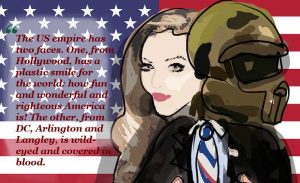
Throughout human history the world’s most dominant powers have suffered from a profound pathological aversion: they cannot bear to admit they are empires. 1 The tragedy of America’s imperial experiment is that denial of its true nature has made its ultimate collapse inevitable. Because Washington can’t admit it is an empire, it is incapable of rational imperial statecraft.
*
As I said last month the reality of the US empire as a thing, and by any number of objective measures the greatest threat to peace on earth, is one of three cardinal divides between me and what would otherwise be my natural peer group in the liberal boomer intelligentsia.
The other two being the reality of class in the oppositional sense of rulers and ruled, 2 and the systemic corruption of corporate media including its ‘liberal progressive‘ wings.
So I’m again indebted to my good friend Dave Hansell for alerting me to a post yesterday from a source not known to me. Such is the reach of Western media propaganda and, increasingly, censorship – try accessing RT (née Russia Today) by corporate browser! 3 – that most educated Westerners, no longer able to tell cynicism from scepticism, will instinctively regard as suspect a writer with the byline, Russia Truth.
I urge you to set aside that suspicion and judge this piece on its merits. It’s not perfect, but does offer an incisive assessment of the US empire from a military, a financial/economic and, no less important, a psychological perspective. Not bad going for a piece that barely tops a thousand words. The graphics help. Thanks for the heads up, Dave.
NB I’ve twice – in sections 1 and 2 – shoe-horned black unindented comment into the indented red I use for third party text. If pushed for time, or keen to avoid impeding the flow, skip them.
*
The Empire that Dare Not Speak Its Name: Post-WWII America, Cognitive Dissonance, and the Pathology of Denying Conquest
To observe the modern administrative state of the United States in the mid-2020s is to witness an empire in the terminal stages of psychological distress. As the physical foundations of its global proxy spaces collapse under the weight of severe energy deficits, industrial exhaustion, and un-winnable military standoffs from the Donbass to the Persian Gulf, the Washington political class remains trapped in a state of advanced, clinical cognitive dissonance.
Throughout human history, with only a few brief, fleeting exceptions, the world’s most dominant powers have suffered from a profound pathological aversion: they cannot bear to admit they are empires.
For post-World War II America, this denial is not merely a public relations strategy. It is a deep-seated structural necessity. To acknowledge the truth—that the United States operates a sprawling, global tribute-extracting hegemony enforced by kinetic violence, client-state manipulation, and economic coercion—would shatter the foundational myth of “American Exceptionalism.” It would force a nation built on the self-image of a liberty-loving republic to confront the reality that it has become the very monster its founders revolted against: a rapacious global empire built on raw, evil conquest.
1. The Historical Pattern: The Mask of the Civilizing Mission
The American refusal to speak the word “empire” is the continuation of a long, historic lineage of imperial self-delusion. Across millennia, the architects of global subjugation have consistently framed their predatory expansion not as raw, material conquest, but as a moral, altruistic duty.

- The Roman Illusion: The Roman Republic systematically dismantled its neighbors while continuously maintaining that every war it fought was strictly defensive. Even as the Caesars established absolute, autocratic rule over the known world, they preserved the hollow symbols of the Senate to pretend the Republic still breathed.
- The British and French Alibis: The British Crown did not conquer India or Africa for raw material theft; they did it to “civilize” the native populations and introduce the rule of law. The French Republic colonized Indochina under the banner of mission civilisatrice.
- The Symmetrical Inversion: In every case, the ruling elite understood that raw conquest—the naked, physical subjugation of foreign populations for land, resources, and tribute—is fundamentally viewed by humanity as an objective evil. To maintain domestic stability and keep the peasant class marching to the front lines, the state must invent an altruistic narrative shield.
This section is an oversimplification. Like capitalism, feudalism and even slavery, empires – US, British, French or Roman – had objectively positive aspects in their advancement of productive forces, 4 and in the truth that Pax Romana, Pax Americana etc are not entirely reducible to self serving fabrications. 5 But also like capitalism and slavery, empires in decline resort, albeit with diminishing effect, to the violence there from the get-go: against those they must subjugate to exploit and – witness the 20th century’s two global conflagrations – against rival imperialisms.
Within the constraints of so short a piece, Russia Truth pretty much gets right the big picture.
2. Post-WWII America: The Architecture of the Invisible Empire
Following the industrial self-immolation of the European powers in 1945, the United States assumed absolute command of the global financial and military architecture. Yet, unlike the British or the French, Washington chose not to plant flags, paint the map red, or install formal colonial governors. Instead, they pioneered the Invisible Empire.
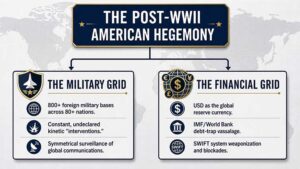
By utilizing the dollar as the global reserve currency and weaponizing international lending institutions like the IMF and the World Bank, Washington established a system of economic extraction far more efficient than the British East India Company ever dreamed.
Alluded to here is that Bretton Woods 1944 established a US dollar tethered to gold as global reserve currency. Economist John Maynard Keynes, its architect, had wanted a neutral currency, the bancor, to do the job. But with Europe in ruins, bled out by war on an unprecedented scale and its colonies agitating for their freedom, the world’s new and relatively unscathed hegemon was in no mood to let such an advantage slip through its fingers.
Least of all when its vaults held 80% of the world’s gold.
When the Nixon Shock of 1971 decoupled dollar from gold – America’s war on the Vietnamese people having drained federal reserves – it was seen at first as a humiliation. Two years later, with the OPEC crises and arrival of the petrodollar, the advantages to Washington and Wall Street of a fiat dollar as global reserve became clear. France’s Valery Giscard d’Eistang called it “America’s exorbitant privilege”, while Nixon’s Treasury Secretary, John Connelly, told European counterparts that the dollar is “our currency but your problem“.
With its creditors obliged to hold trade surpluses in dollars or US Treasury bonds, 6 America has for half a century been the only nation ever to make debt pay. 7 Now though, in Greek tragedy fashion, Washington’s efforts to cling to its post-USSR supremacy by, inter alia, weaponising SWIFT and seizing the Western held assets of disobedient states – serve instead to hasten its demise. As Russia, China and even Japan are incentivised to shed dollars, and Russia and China to build alternative transnational payment systems, the global south watches from the benches as an epic struggle takes alarmingly overt and kinetic forms. Still in the imperial orbit, and duly noting the lawless ease with which Russian, Iranian and Venezuelan assets in the West were by unspoken edict ‘frozen’, the world’s semi-colonies drew appropriate conclusions for their own holdings, should they too displease Washington, but remain too exposed to the punitive reach of Uncle Sam to fully embrace multipolarity and BRICS. 8 9
In a prenuclear age, WW3 would already have happened.
If a foreign nation attempted to reclaim its sovereign resource wealth—such as Iran in 1953, Guatemala in 1954, or Chile in 1973—the CIA quietly orchestrated its decapitation, replacing popular leaders with submissive military juntas.
Yet, because there was no formal colonial office in Washington, the American public could remain completely insulated from the reality of their state’s actions. They could watch television news programs celebrating the defense of “freedom and democracy” while their military-industrial complex systematically liquidated millions of lives across the Global South to preserve the dollar’s transactional monopoly.
3. Cognitive Dissonance: The Pathology of Self-Deception
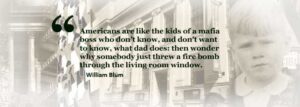
The psychological consequence of this invisible conquest is a state of permanent, institutionalized cognitive dissonance. The American citizen is raised on a cultural diet of revolutionary folklore—celebrating the underdog rebels who threw off the yoke of George III.
To hold this identity of the “anti-imperial liberator” in one hand, while simultaneously funding a global military machine that operates over 800 foreign bases and drops high-precision bombs on sovereign nations in the other, requires a massive, continuous act of psychological self-mutilation.
This dissonance explains the frantic, highly emotional nature of American political discourse. When independent, dissident voices point out the obvious structural reality of the American empire, the response from the corporate media and the political establishment is not rational debate, but immediate, hysterical denunciation. The truth must be suppressed with absolute, desperate fury because the alternative is too horrifying for the American mind to contemplate: the realization that they are the bad guys.
They must pretend that their endless wars are always “humanitarian,” that their economic blockades are “targeted sanctions against dictators,” and that their military encirclement of competitors like Russia and China is merely “defending the rules-based international order.”
4. The Sunset of the Denial Machine
The tragedy of the American imperial experiment is that the denial of its true nature has made its ultimate collapse completely inevitable. Because Washington refuses to admit it is an empire, it is physically incapable of practicing rational imperial statecraft.
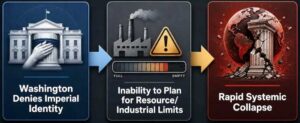
A rational empire—like Rome or Britain in their prime—understands its physical and material limits. It knows when to consolidate, when to strike deals with rival powers, and how to manage its resources to prevent terminal overstretch.
But the United States, blinded by its own exceptionalist theology, believes its power is infinite and divinely sanctioned. It cannot retreat, it cannot compromise, and it cannot negotiate because to do so would be to admit that it is a conventional, earth-bound empire subject to the physical laws of history.
As the Western energy reserves empty, as China tightens its grip on the critical rare-earth elements that feed the G7 defense complex, and as the Middle East is engulfed in an un-winnable war of attrition, the invisible empire is running out of track. The “rules-based order” has dissolved into a hollow punchline.
The cognitive dissonance is finally breaking under the weight of material reality. The curtain is falling, the lights are going out across the industrial core, and the nation that spent eighty years denying its imperial status is about to face the ultimate, unyielding historical verdict: the collapse of an empire that was too cowardly to ever call itself by its real name.
* * *
- ‘Russia Truth’ is cavalier here. As a child I recall school celebrations of British Empire Day, which only ceased in 1958. Empires prior to the 20th century – Roman, French and British to use RT’s examples – took immense pride in their status as such. RT thereby misses the vital point that modern imperialism is defined not by direct rule but by north-south export of capital, south-north repatriation of profits. The latter is not only more cost-effective, at least until recently, but allows the very denial RT speaks of. America indeed “cannot bear to admit” its imperial status, and the consequences are indeed as RT sets out so cogently. But US imperialism, like that of the West’s junior imperialisms – many but not all of them postcolonial powers – is qualitatively different in ways which allow the myth, convenient in more ways than one, of independence in the global south. It is historically and more to the point analytically wrong to claim that earlier empires, for all their other self-servingly pious falsehoods – “white man’s burden” and the like – denied their imperial status.
- Under capitalism, “rulers and ruled” equates to capital owners and labour sellers, the former deploying their considerable resources to convince the latter their interests are not in fundamental opposition.
- To bypass some censorship at least, and for good measure counter intrusive surveillance, I recommend downloading and installing Tor browser.
- “British” India, for example, was the second country in the whole wide world to have a fully integrated railway network.
- US fiscal and monetary hegemony had its upside in facilitating global trade, which is why China still has so ambiguous a relationship with the dollar.
- Non US creditors may buy into but not take majority stakes in US companies. Hardly less significant is that the petrodollar system – the Faustian Pact whereby OPEC could charge what it likes, so long as all transactions were in US dollars – meant that net importers of oil, i.e. most countries whether or not they run trade surpluses with the US, must hold and by that fact boost the dollar regardless of the state of the US economy.
- For a quick read on how America’s debt funds a yearly arms spend approaching one $trn, hence those 800+ military bases encircling the planet – and that’s just the ones we know about – see Who pays for the US war machine?
- I’m no expert but the consensus among those who claim to be such is that BRICS is still a long way from posing a serious challenge to dollar hegemony.
- Storing their gold, let alone their dollars, elsewhere in the West was shown to afford scant protection for states in the global south when the UK, doubtless on Washington orders, ‘confiscated’ Venezuelan gold held in London vaults.
Funnily enough I partly watched a The Duran piece (could not get through it without groaning actually) this morning entitled “Secret 1944-1954 Architecture That Still Rules Us Today w/ Mel K” https://www.youtube.com/watch?v=hISDTLdoJFM which seemed to trot out many of the delusions, that if only it were not for the Federal Reserve or secret cabals etc. the US would indeed by that shining beacon on the hill bringing democracy and human rights to the world. Part of that delusion referred to with USAans unable to acknowledge their empire as a problem. The problems are caused by “others”, they are the bad guys
Thanks for the Duran alert, Gerald, I’ll watch later. Both Alex and Alexander can be a tad verbose, especially on their own, but are too useful to ignore and in any case have taken to making some of their podcasts shorter – at 10, 15, 20 or in this case 30 minutes.
This is interesting, suggesting that it would be possible for empires to manage decline and assimilation into a new world order – or at least postpone the inevitable. I have often wondered why Ruling Classes find it so difficult to give modest gains to other classes ( or in this case other countries / economic blocks) in order to maintain overall control. I guess internal base and superstructure contradictions become too acute to manage and undermine attempts by membets to act as a class.
To paraphrase Kipling: ‘Greed, hot greed, is the master of them all’ – combined with tunnel vision and short sightedness. The ‘short-sightedness is probably associated with capitalism’s natural focus on short-term gains and abhorrence of long term (socialistic) planning.
Precisely. Which is why – look no further than the abundance of signs indicating catastrophic global warming – Rosa Luxemburg was right to declare more than a century ago that the stark choice confronting humanity is socialism or barbarism.