
This post is a third party follow up, by a Mondoweiss whose daily newsletter I recently – Iran flips the script: an Arab perspective – urged readers to subscribe to, of two other posts. One concerned the draconian and egregiously unfair sentences handed down five days ago by a severally compromised judge to Britain’s Filton Four, the other my tersely ad hoc response – UK Court of Appeal backs genocide – to the June 15 overturning of Palestine Action’s short lived victory in the form of a February High Court ruling that the unprecedented proscription last year, as a “terrorist” entity, of a direct action group targeting property not people had been disproportionate and unlawful.
Here’s Mondoweiss in greater detail on the mockeries of justice and much vaunted separation of executive and judiciary powers of a British state too deeply entwined with a genocidal settler colony to indulge such niceties.
In landmark case, UK judge sentences pro-Palestine activists as terrorists
In a UK first, a judge sentenced four Palestine Action activists to terrorism charges for a direct action protest against an Elbit Systems factory. The move sparks fears the ruling could set a dangerous precedent for those opposing Israel’s genocide.

On June 12, 2026, a UK judge at Woolwich Crown Court convicted four Palestine Action activists as terrorists and sentenced them to prison for their involvement in a direct action protest at a factory operated by Elbit Systems, Israel’s largest weapons manufacturer, which reportedly caused £1.2 million in damages.
This is the first time in the UK that counter-terrorism legislation has been used against activists. There are now major concerns that this will set a dangerous precedent for other activists who oppose Israel’s genocide against Palestinians in Gaza and in ethnic cleansing in the West Bank.
Palestine Action members Charlotte Head and Leona Kamio were sentenced to 6 years, less 45 days, while Fatema Zainab Rajwani was sentenced to 5 years and 8 months, less 45 days, under a clause in terrorism legislation for causing criminal damage. Samuel Corner was also sentenced to eight years and eight months, including an additional sentence for grievous bodily harm without intent.
The raid carried out by the six activists on the Elbit factory in Filton, UK took place in August 2024, where it is reported that they destroyed 40 “military assets” including the ‘Magni X’ drone and multiple ‘Thor’ drones; both of which have been deployed extensively in Gaza by the Israeli military.
The activists were arrested on-site. An additional 18 people were arrested in connection with the raid as part of ‘Operation Recomply’ and were subsequently dubbed the ‘Filton 24.’ In May 2026, they became the ‘Filton 25’ after the Crime Prosecution Service decided to advance Lewis Chiaramello’s verdict regarding his alleged involvement in an action at RAF Brize Norton airbase.
During the sentencing, more than 500 people gathered outside the court to support and show solidarity with the activists, displaying banners, performing music and poetry, and chanting. A large contingent of police officers was present and made more than 100 arrests, predominantly for displaying support for Palestine Action, which the British government proscribed as a terrorist organization in July 2025.
Other arrests followed later, after a blockade of a prison van carrying some of the activists as it left the court premises. The vehicle remained stationary for over an hour until protesters were removed by police, who are accused of using disproportionate force and conducting violent arrests.
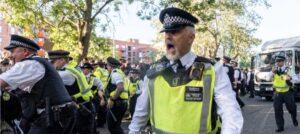
Police push back protesters blocking a prison van holding PA activists. (Photo: Aidan Frere-Smith)
An unprecedented trial
The sentences were delivered at the end of an unprecedented trial.
Following their action on the August 6, 2024, Samuel Corner, Jordan Devlin, Charlotte Head, Leona Kamio, Fatema Rajwani and Zoe Rogers were all initially charged with criminal damage and aggravated burglary. An additional charge of violent disorder was given to Corner, Head, and Kamio.
Using counter-terrorism powers, the six were denied bail and remanded in custody, despite being charged with lesser offenses. They remained in prison until their court trial was concluded in February 2026, beginning in November 2025; nearly 18 months after arrest.
None were initially convicted of any offense as the jury failed to reach verdicts on the charges of criminal damage and violent disorder, and all were acquitted of aggravated burglary. Unsatisfied with the outcome, prosecutor Deanna Heer KC confirmed that a retrial would be pursued.
The retrial concluded on May 4, 2026 and found Samuel Corner, Charlotte Head, Leona Kamio, and Fatema Zainab Rajwani guilty of criminal damage. Corner was also found guilty of inflicting grievous bodily harm without intent. Devlin and Rogers were acquitted.
Once court-imposed reporting restrictions were lifted on May 12, 2026, it was revealed that a significant factor was withheld from the jury during deliberations – that a guilty verdict could trigger a ‘terrorist connection’ clause under the Counter-Terrorism and Sentencing Act 2021 at sentencing.
Going further, the defendants’ barrister, Rajiv Menon KC, faced contempt of court proceedings for his closing speech in the 2024 trial and was accused of defying the judge’s orders, Sir Jeremy Charles Johnson KC.
The judge ruled that the defendants could not argue that they had a lawful excuse based on the actions of the Israeli military in Gaza, and also forbade lawyers from inviting the jury to disregard the court’s rulings of law or to apply the principle of jury equity, a jury’s right to acquit defendants based on its own judgment of conscience or sense of fairness.
In his closing speech, Menon told the jury about the landmark 1670 legal decision Bushel’s Case, which established the independence of juries. He also read from a plaque at the Central Criminal Court, highlighting the case’s significance and quoting it as saying, “established the right of juries to give their verdict according to their convictions.”
This was the point of contention for Johnson and is believed to be the first time in UK legal history that contempt of court proceedings have been brought against a barrister for his closing argument …
Read the full piece, whose closing paragraphs reference Monday’s reversal of Palestine Action’s February victory in the High Court, on the Mondoweiss site …
* * *