
Power still depends on the ability to impose costs. But the more important measure may increasingly be the ability to absorb them.
*
While most media focus, including this site’s, has been on Washington’s criminal war on Iran, the proxy war on Russia in Ukraine continues apace. In an age of drones and hypersonics, the once mighty aircraft carrier as an attack rather than defensive warship has become an exercise in floating pointlessness as US Admiral Mitch Bradley keeps the three currently in the region – Gerald R. Ford, Abraham Lincoln, George H.W. Bush – 1100 kilometres from the Hormuz Strait, while the morale of those aboard plumbs new depths.
Meanwhile, equally altered war theatre realities in Ukraine have redefined ‘strategic depth’, as discussed in this August 11 post on Duran Daily.
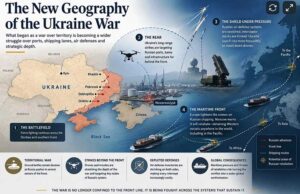
The New Geography of the Ukraine War
What began as a war over territory is becoming a wider struggle over ports, shipping lanes, air defenses and strategic depth.
Ahem … as kickers go, this is a shaky start to an otherwise good post. Whether we call Russia’s intervention, after eight years of civil war in Ukraine’s Donbas, an invasion or a special military operation matters little. What does matter, as I wrote in a footnote to my 2023 post, NATO/EU leaders fear US-Russia talks, is that:
Propaganda aside, two factors led Western media and politicians to attribute goals to the Kremlin whose non achievement could be derided as defeats. One is falling for their own spin in taking Moscow’s declared aims of Kiev neutrality, self-determination in the east, and ‘denazification’ as cover stories for a land grab. The other is that NATO generals with no experience of fighting a peer adversary, even by proxy, misread at every turn what the Russians were doing. Since the second miscalculation boils down to mistaking a war of attrition for one of territorial conquest, the two are causally related.
It’s not that territorial advance is unimportant; rather that, as the February 2022 SMO – with its 100,000 strong force nowhere near sufficient for a war of conquest in Europe’s second largest country – morphed into a war of attrition between Russia and the collective West, the latter’s understanding of what it had worked long and hard to provoke fell a mile wide of the mark.
Just saying. My carp here takes nothing away from the Duran’s primary argument that this war has redefined ‘strategic depth’ in a manner whose implications go beyond Ukraine.
Modern wars are rarely decided only where armies meet. They are decided by the infrastructure behind them: the ports that move exports, the air-defense batteries that protect cities, the factories that replenish missiles, the shipping lanes that preserve revenue and the logistical networks that keep forces supplied.
That is increasingly the shape of the Russia–Ukraine war.
The immediate battlefield still matters. Russian forces are advancing around Pokrovsk, Dobropillia, Orikhiv and other contested sectors, while Ukrainian formations remain under pressure across parts of the Donbas. But the strategic contest is moving outward from the front. Ukraine is attempting to impose costs deep inside Russia. European governments are putting greater pressure on Russian-linked shipping. Moscow, in turn, is demonstrating that it intends to make those strategies reciprocal.
The result is a war in which the distinction between front and rear is becoming progressively harder to maintain.
The Economics of Penetration
Ukraine’s long-range campaign illustrates the problem.
A major drone attack has again targeted Novorossiysk and Crimea, part of a growing effort to strike Russian infrastructure far beyond the battlefield. According to figures cited in the draft, Ukrainian long-range attacks on Russia tripled between January and June.
Yet the same figures suggest only 5 to 9 percent of incoming missiles and drones penetrate Russian air defenses.
That ratio matters more than the headline number of attacks.
If increasingly large salvos are required to place a relatively small number of weapons on target, the campaign becomes a contest of production economics. Ukraine must manufacture or acquire sufficient drones and missiles to saturate defenses. Russia must produce enough interceptors, electronic-warfare capacity and replacement systems to absorb them.
The strategic question is therefore not simply whether an attack succeeds. It is which side can sustain the exchange longer.
Russia appears increasingly confident about the answer. Its missile production is reported to be accelerating, while Ukrainian air-defense stocks are becoming more constrained. F-16s are increasingly being used to intercept drones, reflecting the pressure on the broader defensive network. South Korea’s refusal to provide additional air-defense systems reinforces the same reality: sophisticated interceptors are scarce because governments facing their own security requirements are reluctant to surrender them.
The air war is becoming an industrial competition.
Pressure Moves to the Sea
The same logic is now extending into the maritime domain.
European efforts to disrupt Russian oil exports and Russian-linked shipping were designed to impose additional economic pressure on Moscow. Putin’s latest warning changes the calculation by threatening symmetrical retaliation.
If Russian commercial vessels or cargoes are seized, Moscow says it may detain Western vessels in return—including far beyond European waters.
That transforms what might appear to be an enforcement campaign into a potentially global contest over commercial shipping.
Russia’s Pacific Fleet has already mapped significant volumes of maritime traffic through its region, according to the draft, identifying hundreds of vessels sailing under flags Moscow regards as unfriendly. This is important because European governments possess considerable regulatory and financial leverage over shipping, but they do not possess uncontested naval dominance everywhere Russian forces operate.
The geography of coercion therefore begins to change.
Measures taken in the Baltic, Mediterranean or Black Sea can potentially generate responses in the Pacific or Arctic. A European action against Russian commerce can create risks for European commerce thousands of kilometers away.
The Ukraine conflict is thereby testing a proposition that has shaped much of Western strategy since 2022: whether economic and military pressure can remain largely one-directional.
Moscow is increasingly insisting that it cannot.
The Battlefield Still Sets the Clock
None of this makes territorial warfare secondary.
Russian advances around Pokrovsk, Dobropillia and Orikhiv increase pressure on Ukraine precisely because they force Kyiv to defend the front while simultaneously devoting scarce resources to the rear.
Every interceptor protecting Kiev or Odessa is part of the same strategic balance as every drone launched toward Novorossiysk. Every air-defense system retained by another country rather than transferred to Ukraine affects that balance. Every attack on port infrastructure connects the battlefield to export routes, industrial capacity and national revenue.
This is why the apparent divergence between Russia’s territorial advances and Ukraine’s increasingly ambitious long-range strikes may actually describe the same strategic problem.
Ukraine needs to impose costs beyond the immediate battlefield because the battlefield itself is becoming increasingly difficult to stabilize.
Russia, meanwhile, is attempting to preserve the logistical and industrial depth that allows it to continue operations while simultaneously degrading Ukraine’s ability to do the same.
The war is therefore becoming less about individual strikes than about the resilience of entire systems.
Strategic Depth Is No Longer Geographic
For much of military history, strategic depth was measured in distance. Large states could retreat, absorb losses and relocate resources away from the front.
Technology has changed that calculation.
Drones can reach ports hundreds of kilometers from the battlefield. Missiles can strike energy infrastructure far behind defensive lines. Naval pressure can threaten commercial routes on another side of the world. Economic sanctions can target revenue without occupying territory.
But greater reach does not eliminate strategic depth. It changes what strategic depth means.
The decisive asset is increasingly the ability to absorb repeated disruption without losing operational capacity.
Russia’s advantage is therefore not simply territory. It is the combination of industrial production, air-defense density, maritime reach and logistical scale that makes attacks on its rear expensive to convert into decisive strategic effects.
Ukraine’s problem is the inverse. It must protect a smaller infrastructure base with increasingly scarce defensive resources while continuing to hold an active front.
That asymmetry is becoming central to the war.
The deeper lesson extends beyond Ukraine. The international system is entering an era in which coercion increasingly generates counter-coercion. Sanctions invite alternative trade routes. Ship seizures invite threats against shipping. Long-range strikes generate deeper defensive networks and retaliatory campaigns.
Power still depends on the ability to impose costs.
But the more important measure may increasingly be the ability to absorb them.
* * *
The ability to maintain production of armaments and supply them to replace those destroyed in military actions has always been crucial to winning, or at least avoiding defeats, in war. A number of years ago when researching the military power of the historical city state of Venice I was struck by how few naval battles it actually won. But it was always first to provide , provision and deploy a replacement fleet after a large naval engagement that had resulted in significant loss and destruction. Replacement fleets were often deployed within months – and thus naval dominance immediately restored
Interesting. We’ve been pals nigh on 50 years yet I never knowed you had a thing for military history. Me too, in my own dilettantesque way.
Readiness to take losses applies as much psychologically as logistically. In America’s war on the Vietnamese people, the US media propaganda machine, though less honed than today’s, routinely cited high Viet and low GI losses as proof it was winning. Look how that turned out.
More to the point, if Washington thinks Iran will cry uncle anytime soon, it yet again has another think coming. The Iranian people are not only fully behind their leadership on this war, but inured to hardship by economic and (think the US backed Saddam) military assault for, again, nigh on 50 years.